
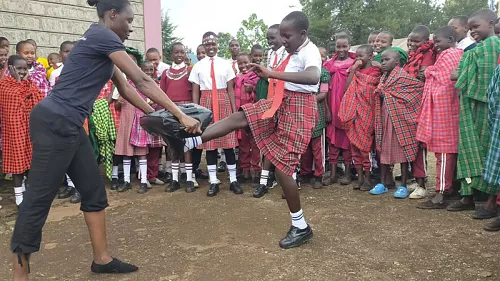
“No, no, no!” the girls shout as they strike a cushion, practicing self-defence techniques. But this isn’t a martial arts club—it’s a boarding school in Transmara, Kenya, that also serves as a refuge for Maasai girls escaping early marriage and female genital mutilation (FGM).
Fourteen-year-old Grace Musheni has been living and studying at the Enkakenya Centre for Excellence since 2023. “We learn how to protect ourselves, how to protect our bodies, and even educate our parents,” she says. Founded in 2009, the centre provides not only a safe haven but also free high school education, encouraging parents to keep their daughters in school instead of subjecting them to FGM—a ritual still practiced among Maasai girls aged 8-17, depending on their birth-year within their age-set.
Once a girl undergoes circumcision, she is considered an adult and ready for marriage, cutting short her childhood and education. While Kenyan law bans both FGM and marriage under 18, these traditions persist, especially in rural areas with low education levels. According to Kenya’s 2022 Demographic and Health Survey, 56.3% of women with no education had undergone FGM, compared to just 5.9% of those with more than secondary education.
Education also impacts gender-based violence. The survey found that 34% of Kenyan women had experienced it, though this number dropped to 23% among those with higher education. However, 23% is still alarmingly high. That’s why the Enkakenya Centre now partners with I’m Worth Defending (IWD) to teach self-defence techniques to all students.
The training isn’t just about fighting off attackers—it’s about empowerment. “We train them in assertiveness and boundary-setting, using both verbal and physical techniques,” explains Amelia Awuor from IWD. “These skills give them confidence to speak up against violations or defend themselves if necessary.”
Self-defence can also protect girls from sexual abuse, which often forces them into unwanted marriages. “A man can defile you, but parents may see marriage as the easiest solution. They send you to him as his wife and take back the cows as bride price,” Musheni explains.
Fifteen-year-old Purity Risanoi has been at the school for five years. Though her widowed mother worked hard to support five children, cultural pressures remain strong. “My parents still follow traditional practices, which puts me at risk of FGM, early marriage, and sexual abuse. But now, I have the skills to stand up for myself,” she says.
Her ultimate plan? Keep studying. She dreams of becoming a lawyer. Musheni, meanwhile, hopes to be a software engineer—using technology to uplift her community.

