
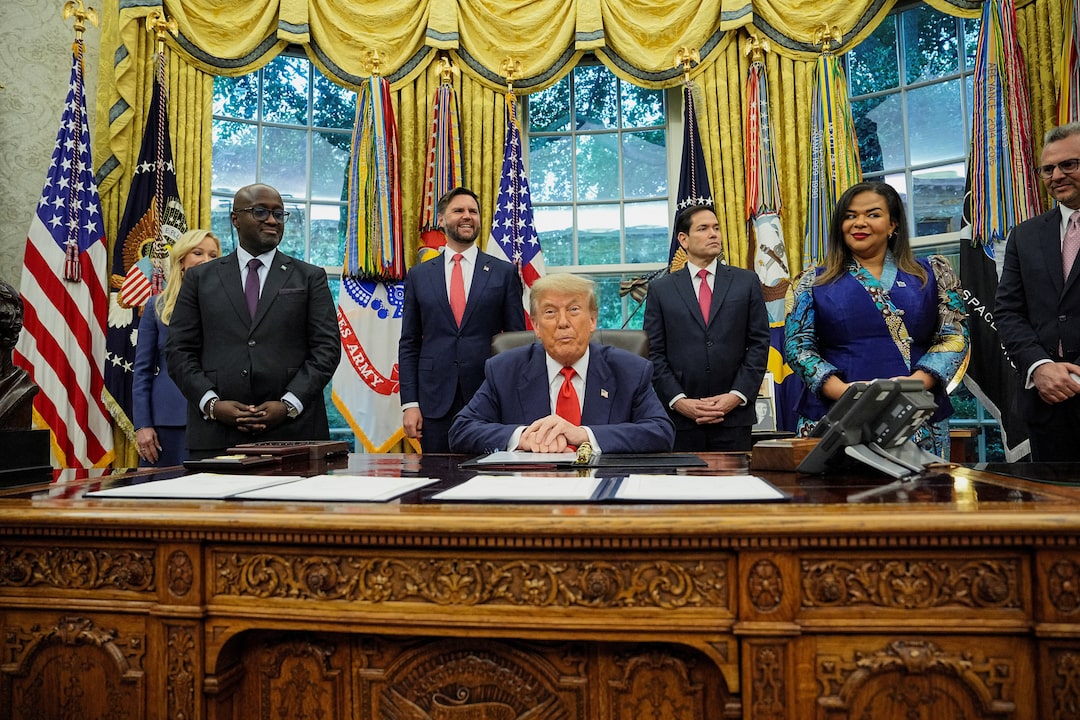
Rwanda and the Democratic Republic of Congo (DRC) signed a peace agreement in Washington on Friday, in a renewed effort to end a years-long conflict that has devastated eastern DRC and claimed thousands of lives. The deal—brokered with Qatari support and signed at the U.S. State Department—aims to stop the backing of armed groups and restore stability in the mineral-rich region. However, many observers remain cautious about its long-term effectiveness.
U.S. President Donald Trump, who welcomed the foreign ministers of both nations to the White House, hailed the agreement as a diplomatic success. “Today, the violence and destruction comes to an end, and the entire region begins a new chapter of hope and opportunity,” he said, also noting the potential for U.S. access to Congolese minerals, calling it a “wonderful day.”
The peace pact comes after renewed violence from the M23 rebel group, a Tutsi-led militia alleged to be supported by Rwanda, which recently seized key areas in eastern DRC, including the strategic city of Goma. Rwanda has denied involvement but has repeatedly called for the disarmament of the FDLR, a Hutu militia rooted in the 1994 Rwandan genocide.
The agreement demands an end to all state support for armed factions—including the FDLR—and calls on Rwanda to halt what it terms “defensive measures.” Rwandan Foreign Minister Olivier Nduhungirehe stressed that neutralising the FDLR must be prioritised. “The irreversible and verifiable end to state support to the FDLR should be the first order of business,” he said.
Still, Nduhungirehe urged caution, pointing to a long history of failed peace deals in the region. “We must acknowledge that there is a great deal of uncertainty in our region, and beyond, because many previous agreements have not been implemented,” he said.
Congolese Foreign Minister Therese Kayikwamba Wagner underlined the importance of respecting national sovereignty. “It offers a rare chance to turn the page, not just with words but with real change on the ground. Some wounds will heal, but they will never fully disappear,” she stated.
The deal also proposes forming a joint security coordination body and lays out plans—though vague—for a regional economic integration framework within three months.
President Trump, despite showing limited familiarity with the region’s historical context, referenced the 1994 genocide, saying, “They were going at it for many years with machetes.” He also claimed credit for the peace breakthrough, telling reporters that the U.S. stands to gain “a lot of mineral rights from the Congo,” referencing critical resources like cobalt and lithium—materials essential for electric vehicle production and currently dominated by Chinese firms.
International reaction was mostly positive. UN Secretary-General António Guterres called the agreement “a significant step towards de-escalation, peace and stability,” while German and French leaders praised it as a historic moment—one that must be handled with care.
Yet not all voices supported the deal. Nobel Peace Prize laureate Dr. Denis Mukwege, known for his work with survivors of s3xual violence in the DRC, sharply criticised the accord, saying it favours Rwanda and the U.S. “It would amount to granting a reward for aggression, legitimising the plundering of Congolese natural resources, and forcing the victim to alienate their national heritage by sacrificing justice,” he said in a statement.
Physicians for Human Rights also expressed concern, highlighting the lack of mechanisms for ensuring accountability for human rights abuses in the region’s prolonged conflict.
Though the agreement represents a possible step forward, its success will depend on whether the signatories follow through, ensure justice, and deliver real change for the people most affected.

