
In Dakar, Senegal, amidst the hustle and bustle of the American Food Store supermarket, a profound sentiment echoed through the air as the cashier gently swiped a pot of Greek yogurt at the checkout counter. “Finally, we can breathe,” she remarked, encapsulating the collective sigh of relief that seemed to permeate the atmosphere. It was a mere three days following Senegal’s hotly contested presidential election on March 24th, marked by the announcement of provisional results. Yet, amidst the uncertainty, there lingered a tangible sense of change, a renewed vigor for democracy spurred by the election of opposition candidate Bassirou Diomaye Faye.
At 44 years old, Faye assumed office after a tumultuous period marred by political unrest and apprehensions of incumbent President Macky Sall’s potential bid for a third term, having already served 12 years in power. For months, the nation teetered on the edge of anticipation, anxiously awaiting the outcome of the election.
However, following a whirlwind election cycle and the resounding victory of the youthful, anti-establishment candidate—who, remarkably, had been incarcerated a mere 20 days prior—a wave of optimism now sweeps across Senegal. There’s a palpable sense among Senegalese citizens that change has indeed arrived.
On the day of the election, voters flocked to polling stations well before dawn, eager to cast their ballots. Inside the grounds of Nafissatou Niang Elementary School in Dakar, one such polling station, a diverse array of citizens assembled: from individuals adorned in flamboyant boubou robes to elderly gentlemen clad in suits with newspapers tucked under their arms, and even young men sporting counterfeit Balenciaga T-shirts. Despite their differences, they stood united in purpose, silently exercising their democratic right amidst the backdrop of anticipation and hope for a brighter future.
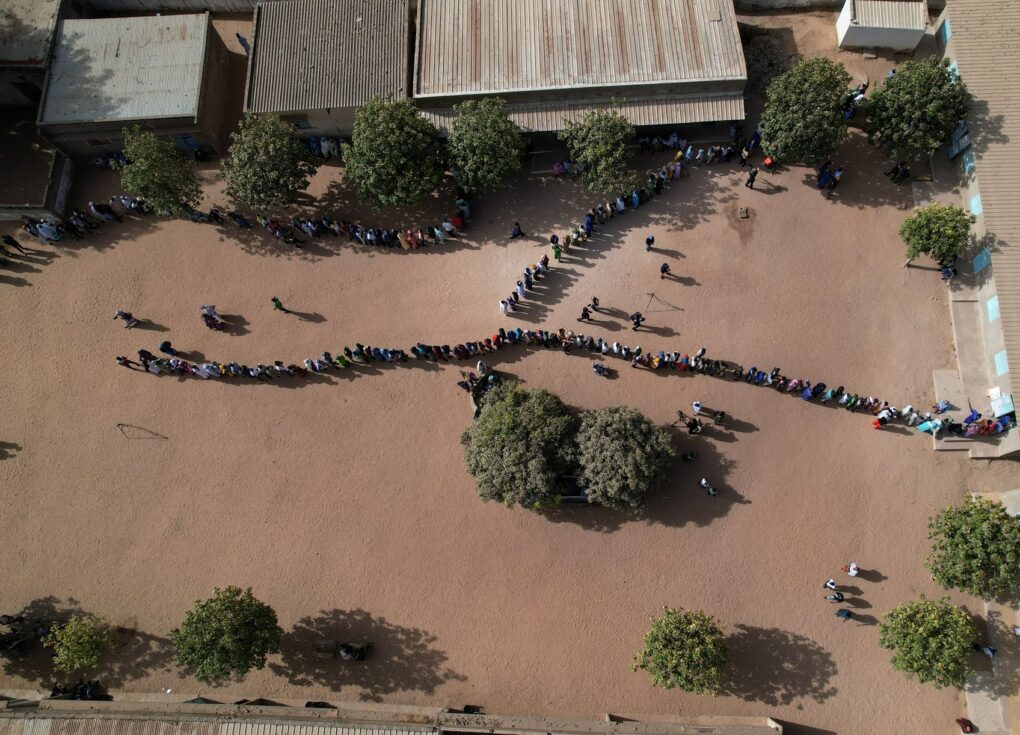
A drone view of people lining up to vote at the polling station at Ndiaganiao in Mbour, Senegal March 24, 2024. REUTERS/Zohra Bensemra
Among the throngs of voters at the polling station stood Julia Sagna, a 37-year-old woman resolute in her determination to wield her vote as a tool of resistance. Draped in a commanding grey power suit, she exuded a poised demeanor, though beneath the surface, a hint of nervousness lingered. This marked her inaugural foray into the realm of voting, a decision she had long deliberated, waiting for the moment when her voice would truly count. “The new, young voters would vote against the system,” she declared with conviction, underscoring her belief in the transformative power of collective action.
Emerging from the polling station with a radiant smile, Julia proudly displayed her ink-stained pinky finger, a tangible symbol of her civic duty fulfilled. “I feel lucky,” she remarked, reflecting on the privilege of participating in the democratic process.
Originally slated for February, the delayed election had been fraught with controversy from its inception. President Macky Sall’s unilateral decision to postpone the proceedings, citing alleged corruption within the ranks of constitutional judges responsible for candidate selection, was met with widespread skepticism. Many viewed it as a desperate ploy to prolong his grip on power, further exacerbating political tensions.
However, the intervention of the Constitutional Council ultimately prevailed, mandating the organization of elections before the expiration of Sall’s mandate on April 2nd. Thus, on March 24th, a significant portion of Senegal’s seven million eligible voters—66 percent, to be exact—mobilized to exercise their democratic rights, signaling a remarkable turnout for a pivotal election.
Amidst the bustling activity at the Medina polling station in downtown Dakar, a diverse array of sentiments simmered beneath the surface. For some, the act of casting their ballot symbolized a quest for justice, while others sought retribution against perceived injustices. President Sall’s twelve-year tenure had been marred by escalating political turmoil, exacerbated by the socio-economic fallout of the COVID-19 pandemic. The attempted arrest of opposition leader Ousmane Sonko in the preceding year had served as a catalyst, galvanizing widespread discontentment with the government’s perceived indifference towards the plight of ordinary citizens.
In the ensuing chaos, riots erupted, and violent clashes ensued, claiming numerous lives and leaving hundreds injured in their wake. Allegations of state-sponsored brutality cast a shadow of mistrust over the ruling party, as opposition factions and civil society decried the impunity with which masked assailants operated, accusing them of perpetrating violence with impunity.
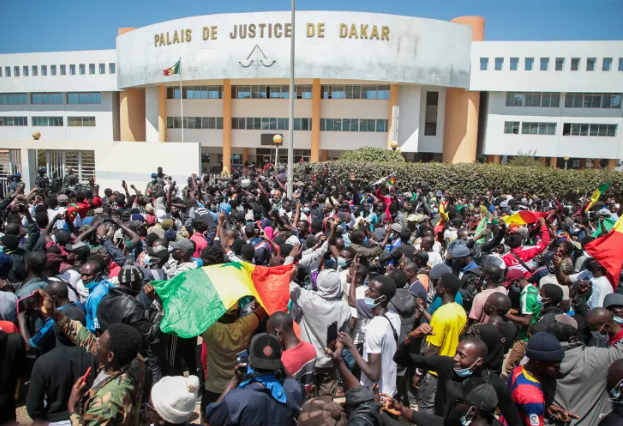
The attempted arrest of opposition leader Ousmane Sonko in 2021 ignited protests against the government [File: Aliou Mbaye/EPA-EFE]
At the time of his apprehension, Faye had been an associate of Ousmane Sonko, another prominent figure in Senegalese political circles and also a former tax inspector. Both men had emerged as leading voices within the union of tax office employees, united in their discontent over perceived injustices and disparities within the tax department.
Sonko, renowned for his fiery rhetoric and eloquent denunciations of corruption, founded the political party PASTEF (African Patriots of Senegal for Work, Ethics, and Fraternity) in 2014. The party served as a rallying point for middle management civil servants disillusioned by rampant graft and the brazen impunity enjoyed by their superiors. Sonko’s meteoric rise to prominence stemmed from his relentless crusade against corruption in the lucrative oil and gas sector following the discovery of natural gas reserves in 2014. However, his outspoken activism eventually drew the ire of the authorities, resulting in his arrest in 2023 on a litany of charges, ranging from provoking insurrection to alleged ties with terrorist groups and endangering state security.
In the aftermath of Sonko’s detention, the government dealt a decisive blow to political dissent by outlawing his party, effectively silencing one of the most vocal opposition voices in Senegalese politics.
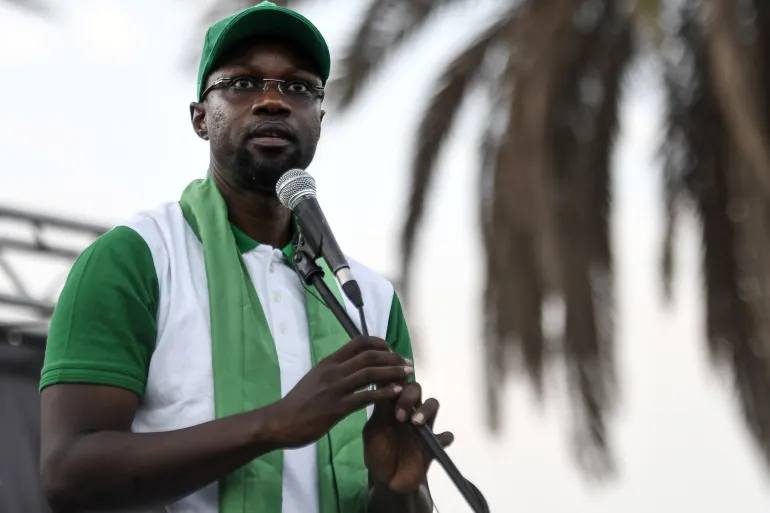
Ousmane Sonko was arrested and jailed in 2023 [File: Seyllou/AFP]
Little did Sonko realize at the time that the very law he vehemently opposed in 2018 would serve as the legal pretext for the subsequent arrest of his deputy and the future president of Senegal, Faye. Fast forward five years, on March 6th, a mere 18 days prior to the pivotal election, President Sall orchestrated the passage of an amnesty bill through parliament. This legislative maneuver aimed to grant reprieve and absolution to all individuals implicated in crimes committed during the political upheaval spanning the years 2021 to 2024.
However, the enactment of this contentious amnesty law elicited vehement criticism from human rights organizations, who viewed it as a thinly veiled attempt to shield security forces and hired operatives from accountability for their involvement in acts of police brutality and the fatal suppression of protesters. Consequently, egregious offenses perpetrated during this turbulent period would now evade scrutiny, perpetuating a cycle of impunity.
Yet, amidst the clamor of dissent, the amnesty decree also paved the way for the liberation of Sonko and Faye, who emerged from captivity less than a fortnight before the impending election, reinvigorating their presidential aspirations and injecting newfound momentum into their campaign.
Meanwhile, the candidate of the ruling party, Amadou Ba, found himself ensnared in a quagmire of public disapproval. Despite the formidable backing of numerous public relations firms, Ba’s messaging fell flat, appearing out of touch with the zeitgeist of Senegal’s youthful populace clamoring for substantive change. His cavalier attitude towards scheduled engagements, often arriving tardily or failing to materialize altogether, further fueled disillusionment among voters. Notably absent from his side was President Sall himself, conspicuously refraining from lending his support to the faltering campaign, thereby exacerbating the disconnect between the ruling elite and the electorate.
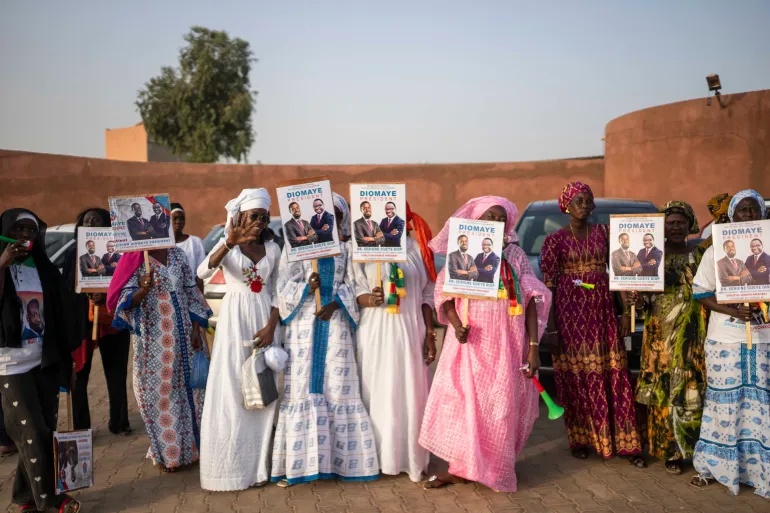
Amidst the fervor of Senegal’s political arena, Bassirou Diomaye Faye and Ousmane Sonko emerged as larger-than-life figures, captivating audiences nationwide with their charismatic presence. They traversed the length and breadth of the country, flanked by vigilant bodyguards tasked with navigating through throngs of impassioned youths clamoring for a glimpse of the dynamic duo—individuals who, despite their humble origins as former tax inspectors, assumed an almost mythic status akin to that of rock stars.
The fervent crowds fervently chanted the mantra of their campaign: “Sonko is Diomaye, and Diomaye is Sonko,” symbolizing the symbiotic relationship between the two political stalwarts. While Faye had previously operated in the shadow of Sonko’s renown, he seized the opportunity to step into the spotlight, wielding a broom as a potent symbol of his promise to usher in sweeping reforms. From advocating for a new currency and the renegotiation of oil and gas contracts to redefining Senegal’s relationship with France and the French language, Faye pledged to prioritize the interests of the Senegalese people above all else, distancing himself from what critics perceived as a government subservient to Western interests, particularly those of France.
Fuelled by overwhelming financial support from the Senegalese diaspora in Europe and North America, Faye and Sonko orchestrated a high-octane, American-style campaign, adopting the moniker “Diomaye Sonko” and rallying under a pan-African banner. Their rallies, reminiscent of grand spectacles, filled stadiums to capacity, illuminated the night sky with dazzling fireworks displays, and captured the imagination of the electorate.
The fruits of their labor materialized swiftly, with victory seemingly assured mere hours after the polls closed. As rival candidates conceded defeat and extended their congratulations to Faye, the magnitude of his triumph became undeniable. By the week’s end, official results confirmed Faye’s ascendancy to the presidency, with an impressive 54 percent of the popular vote.
Transitioning from political prisoner to the youngest leader in Africa in less than twenty days, Faye’s meteoric rise to power was met with jubilation among his supporters. In the aftermath of his historic win, throngs of revelers descended upon Sonko’s residence, where they jubilantly celebrated amidst a sea of green, red, and yellow Senegalese flags. Yet, amidst the euphoria, questions lingered regarding who would wield the proverbial broomstick of authority in Faye’s nascent administration.
For Sonko, whose candidacy was barred due to prior criminal convictions, the victory represented a bittersweet culmination of his tumultuous political journey. Having handpicked Faye as his successor in a pragmatic decision fueled by necessity rather than affection, Sonko reflected on the arduous path that led to this momentous juncture.
Released from incarceration under President Sall’s amnesty law, Faye now embarks on a new chapter as the nation’s leader. However, his journey traces back to humble origins in Ndiaganiao, a rural village located a considerable distance from the capital. It was here that Faye once harbored aspirations of local leadership, albeit unsuccessfully vying for the position of village mayor in 2022—a setback that ultimately paved the way for his ascension to higher office.
Reflecting on his son’s remarkable journey, Samba Faye spoke of overcoming adversity as the cornerstone of Faye’s success, underscoring the indomitable spirit that propelled him from humble beginnings to the pinnacle of power.
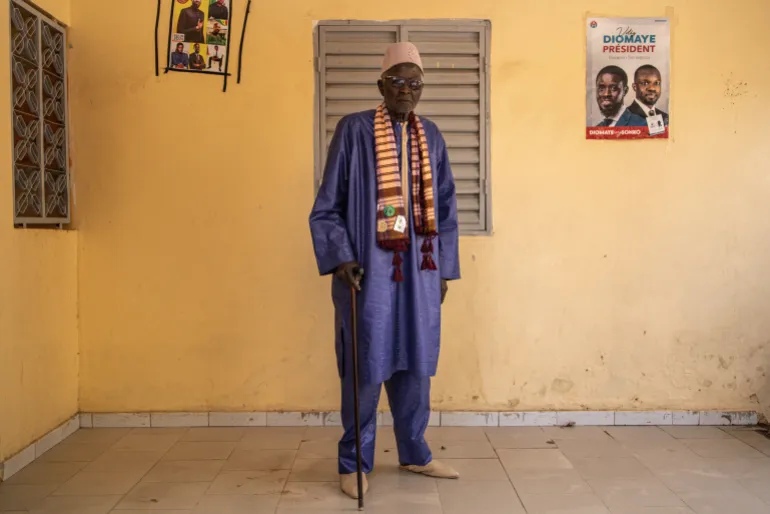
In a humble abode nestled within a sandy settlement, the elder Faye resides in a modest cement dwelling, where remnants of the previous night’s victory celebration linger in the form of blue plastic chairs scattered across the courtyard. Empty pots, once filled with sustenance, now serve as silent witnesses to the jubilation that transpired. Nearby stands a mosque, its presence a testament to the spiritual fabric woven into the community, while in the sandy terrain lies the final resting place of Faye’s grandfather—a revered figure whose legacy casts a long shadow over the family’s lineage.
Among the villagers, the Faye family enjoys a storied reputation, with the newly elected president emerging as a figure of respect and admiration. The legacy of resilience and determination runs deep within their veins, epitomized by the indomitable spirit of Faye’s grandfather, who once waged a battle against French colonial administrators over the construction of a district high school. Forged in the crucible of adversity, this struggle mirrored the trench warfare of World War II, as he steadfastly confronted entrenched systems of oppression that sought to stifle the aspirations of educated Africans perceived as a threat to colonial rule.
Despite facing imprisonment for his convictions, Faye’s grandfather remained undeterred, ultimately triumphing in his quest to erect the school—a testament to his unwavering resolve and commitment to education as a tool for liberation. It was within the hallowed halls of this institution that the future president received his formal education, a journey marked by the toil of his mother and sister as they labored to cultivate cereal grains during his time away from school.
Samba Faye, the patriarch of the family, has long been a steadfast member of Senegal’s Socialist Party, instilling within his son a steadfast commitment to left-leaning ideals from a tender age. Reflecting on his son’s meteoric rise to prominence, Samba Faye acknowledges the arduous path that led to this momentous juncture, underscoring the sacrifices and hardships endured along the way.
“While it is undoubtedly a source of pride to witness my son garnering such acclaim and recognition, one must not forget the pain and labor that paved the path to his success,” he remarks, offering a poignant reminder of the trials and tribulations that shaped the trajectory of their familial journey.
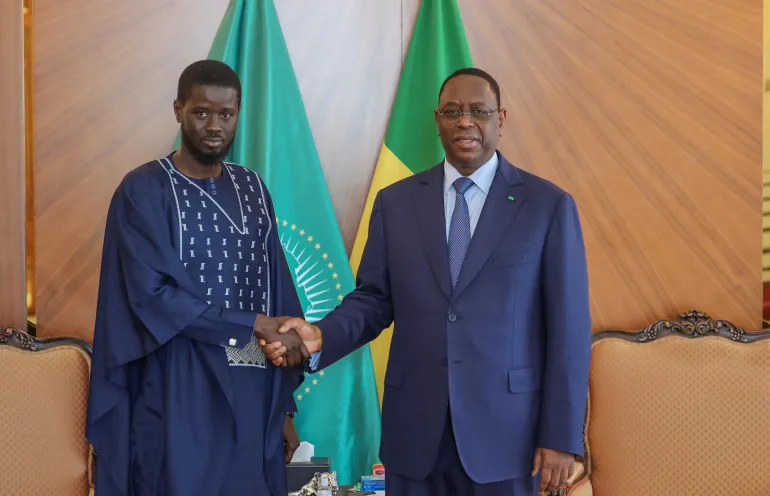
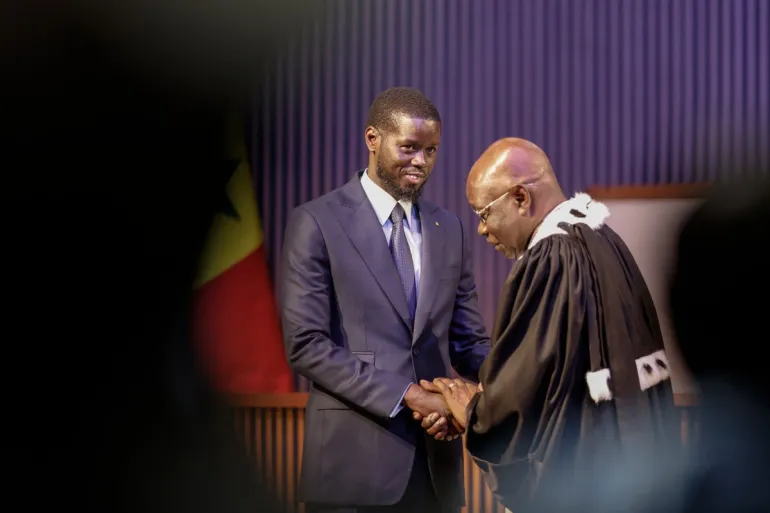
Senegal’s new president, Bassirou Diomaye Faye, left, shakes hands with the outgoing president, Macky Sall [Senegal’s Presidency/Handout via Reuters]
Indeed, Faye’s ascent to the presidency owes a debt of gratitude to Sonko, whose unwavering support and guidance proved instrumental in securing victory at the polls. The intricate interplay between mentor and protege underscores the complexities of Senegal’s political landscape, where personal allegiances wield considerable influence over the trajectory of governance.
As the nation stands on the precipice of transition, divergent sentiments pervade the collective consciousness. For some, apprehension looms large on the horizon, fraught with uncertainty and trepidation over the impending changes. Conversely, others herald the dawn of a new era, infused with the promise of revitalization and progress. Amidst the swirling currents of anticipation and anxiety, one immutable truth emerges: change is inevitable.
In the twilight hours preceding the handover of power, a symbolic tableau unfolds within the corridors of authority. President Sall, resplendent in a tailored suit and tie, extends a hand of camaraderie to his successor, President-elect Faye, and the venerable opposition leader, Sonko—both adorned in traditional attire. While to some, this gesture may seem superficial, devoid of substantive meaning, to the Senegalese electorate who placed their faith in Faye’s vision for the future, it signifies a seismic shift—a tangible manifestation of their collective aspirations for a brighter tomorrow.

