
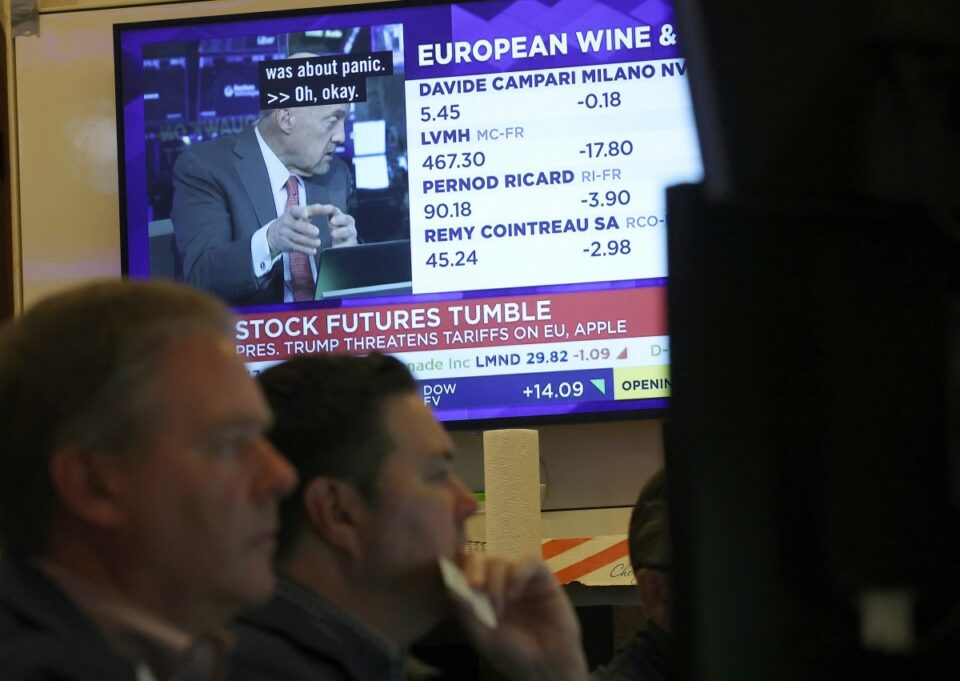
Asian stocks were mixed on Monday after former U.S. President Donald Trump reignited trade tensions by threatening major tariffs on the European Union—before later announcing a delay in their implementation.
Markets had just begun to stabilise after last week’s bond-driven sell-off when Trump warned of a 50% tariff on EU goods starting June 1, calling trade talks with the bloc “going nowhere.” He also threatened to impose 25% duties on smartphone manufacturers that do not produce their devices in the United States.
Wall Street’s major indexes and most European markets tumbled on Friday in response. However, Asian markets saw some relief after Trump revealed on Sunday that he would postpone the EU tariffs until July 9 following a “very nice call” with European Commission President Ursula von der Leyen. He added that officials would “rapidly get together and see if we can work something out.”
In response, Tokyo, Shanghai, and Seoul advanced, while Hong Kong, Sydney, Singapore, Wellington, Taipei, Manila, and Jakarta ended in the red.
The U.S. dollar remained under pressure after declining on Friday.
Analysts said Trump’s shifting trade stance has reintroduced uncertainty for investors. They also warned that his broader economic plans—such as extending tax cuts and reducing spending—could significantly widen the national deficit, pushing up Treasury yields and potentially destabilising the U.S. economy.
“Sunday’s move shows tariffs are being used more as a negotiating tactic than a fixed policy,” said Chris Weston of Pepperstone. “The initial threat may fade, but it still unsettles markets.”
Ray Attrill of National Australia Bank noted that with few major economic events this week, trade tensions are likely to dominate headlines.
Markets will also be watching for the release of minutes from the Federal Reserve’s latest policy meeting and the U.S. personal consumption expenditures (PCE) inflation data due Friday.
Michael Hewson of MCH Market Insights said the Fed’s tone has shifted, highlighting increased risks of both higher unemployment and inflation—complicating its dual mandate.
“The real concern is declining consumer confidence in the U.S.,” Hewson said. “If policymakers realise their confrontational approach is backfiring domestically, we could see a shift.”
In corporate news, shares in Samsung rose more than 1% despite Trump’s smartphone tariff threats. Nippon Steel surged as much as 7.4% in Tokyo after Trump endorsed a new “partnership” between the company and U.S. Steel, following its $14.9 billion acquisition deal announced in 2023. Trump claimed the move would secure U.S. Steel’s Pittsburgh headquarters and create 70,000 jobs, although details remain unclear.
U.S. Steel shares jumped 21% on Wall Street on Friday.
Key Figures as of 0300 GMT:
-
Tokyo – Nikkei 225: +0.5% at 37,329.22
-
Hong Kong – Hang Seng Index: -0.7% at 23,447.04
-
Shanghai – Composite: +0.1% at 3,352.76
Currencies:
-
Euro/Dollar: $1.1395
-
Pound/Dollar: $1.3564
-
Dollar/Yen: ¥142.55
-
Euro/Pound: 84.00p
Commodities:
-
WTI Crude: +0.2% at $61.66
-
Brent Crude: +0.2% at $64.91
Wall Street Close (Friday):
-
Dow Jones: -0.6% at 41,603.07

