
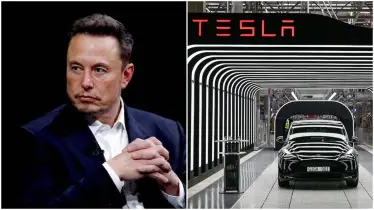
Tesla CEO Elon Musk has confirmed a $16.5 billion chip supply deal with Samsung Electronics, a move expected to breathe new life into the South Korean tech giant’s struggling foundry business.
Under the agreement, Samsung’s new chip plant in Taylor, Texas, will manufacture Tesla’s next-generation AI6 chips. Musk noted that Tesla will play an active role in optimising production at the facility, which is located near his residence. “I will walk the line personally to accelerate the pace of progress,” he said.
In a post on X, Musk added that the $16.5 billion figure is only a baseline, saying, “The $16.5B figure is just the minimum — actual output will likely be several times higher.”
Following the announcement, Samsung’s shares jumped 6.8%, reaching their highest point since September 2024. Tesla stock also rose by 1.9% in premarket trading.
Industry experts view the deal as a major breakthrough for Samsung’s Taylor facility, which had struggled to attract major clients. In October 2024, reports indicated that the company delayed equipment deliveries due to a lack of orders. The Tesla contract now marks a significant turnaround.
Samsung currently produces Tesla’s AI4 chips used in its Full Self-Driving system, while TSMC is handling the production of AI5 chips. With this new agreement, Samsung has secured the more advanced AI6 chips.
Although no exact timeline was disclosed, production of the AI6 chips is expected to begin around 2027 or 2028. Musk had previously stated that AI5 chips would be ready by late 2026.
Samsung, the world’s largest memory chip producer, is working to grow its contract manufacturing segment, which currently holds just 8% of the global market—far behind industry leader TSMC’s 67%.
While the chip deal was initially revealed without naming Tesla, multiple sources have since confirmed the U.S. automaker as the client. The agreement is set to run through 2033.
This partnership arrives at a critical time for Samsung, which is under increasing pressure to compete in the fast-growing AI chip market. Earlier this month, the company projected a 56% drop in Q2 operating profits and reported over $3.6 billion in foundry losses during the first half of the year.
Analysts believe this deal could mark a turning point for Samsung, offering a strategic advantage in the capital-intensive, rapidly evolving semiconductor industry.

