
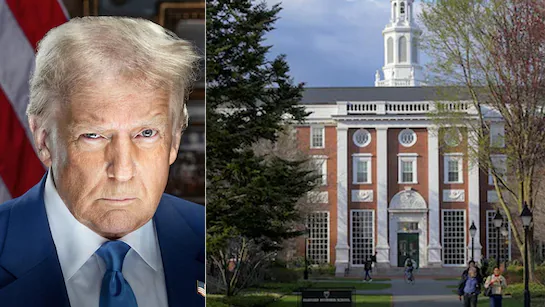
U.S. President Donald Trump has signed a new proclamation suspending the issuance of international visas for newly admitted students at Harvard University, marking a major escalation in the administration’s crackdown on foreign student enrollment.
The order halts the entry of most new international students under the F, M, and J visa categories—the primary routes for academic and exchange programs. It also instructs the Secretary of State to consider revoking those visas from current Harvard students who fall under the new restrictions.
Harvard, where international students make up around 27% of the student body, now faces heightened uncertainty, just days after a federal court blocked a previous attempt by the administration to limit foreign student enrollment.
A Harvard spokesperson criticised the move, calling it “another illegal and retaliatory step that violates Harvard’s First Amendment rights,” and pledged to continue protecting the university’s international community.
The White House described the measure as necessary for national security, accusing Harvard of concealing information about international students, underreporting disciplinary cases, and failing to address issues like antisemitism. Officials also pointed to Harvard’s ongoing emphasis on diversity, equity, and inclusion programs as evidence of alleged ideological bias.
The proclamation allows exemptions for individuals whose entry is deemed to serve the national interest. It does not apply to students enrolled at other U.S. institutions under the Student and Exchange Visitor Program (SEVP). The measure will remain in effect for six months, unless extended, with a review mandated within 90 days by the Attorney General and the Secretary of Homeland Security.
The document states that Harvard’s conduct has made it “an unsuitable destination for foreign students and researchers.”
The decision drew swift condemnation from China, the second-largest source of international students in the U.S. A spokesperson from China’s Foreign Ministry said the move undermines mutually beneficial academic cooperation and labelled it political interference.
This policy follows a recent court ruling barring the Trump administration from revoking Harvard’s SEVP certification, which the Department of Homeland Security had attempted after Harvard refused to hand over conduct records of international students.
Harvard has accused the administration of procedural violations and retaliation, citing the university’s refusal to adopt federal ideological policies.
The administration’s tensions with Harvard have spanned issues including campus speech, faculty hiring, race-conscious admissions, and efforts to combat antisemitism. The Department of Education has warned that failing to protect Jewish students or using race in decision-making could lead to loss of federal funding.
Harvard has also been the target of federal scrutiny over funding. On March 31, Trump officials notified the university of a review into all $9 billion in federal grants and contracts. After Harvard filed a lawsuit over a $2.2 billion funding freeze, an additional $450 million in grants was cut. The administration also threatened to revoke the university’s tax-exempt status.
Last week, the White House directed all federal agencies to cancel remaining contracts with Harvard, totalling nearly $100 million.

