
Here’s a refined version of your text while keeping it close to the original:
Dangote Refinery Holds Over 500 Million Litres of Petrol, Produces Enough for Nigeria and Beyond
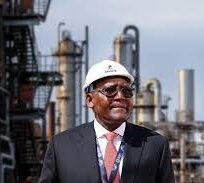
The President of the Dangote Group, Alhaji Aliko Dangote, has disclosed that the Dangote Petroleum Refinery currently has over 500 million litres of petrol in its reservoir.
Speaking during a tour of the $20 billion Lekki-based facility with Zambia’s Minister for Energy, Makozo Chikote, on Saturday, Dangote revealed that the refinery is now producing enough fuel to meet both local demand and export needs.
The Zambian official visited the refinery in Lagos State, seeking collaboration with Dangote to address Zambia’s energy security challenges.
During the tour, Dangote stated that the refinery currently holds N600 billion worth of stock in its tank farm and is on track to reach its full production capacity of 650,000 barrels per day next month. He added that Nigeria’s fuel consumption is less than half of the refinery’s total production.
“We can satisfy more than Nigeria’s local fuel needs. As we speak, we have more than half a billion litres of petrol and over N600 billion worth of stock in the refinery. We produce enough refined products—including gasoline, diesel, and kerosene—to meet 100% of Nigeria’s requirements,” Dangote said.
He also disclosed that arrangements are underway to secure more crude to facilitate the refinery’s ramp-up.
“Now, we are increasing production, and we must reach full capacity by next month. However, securing crude supply involves various arrangements,” he explained.
Unmatched Fuel Quality
Addressing the quality of the refinery’s output, Dangote stated that refineries worldwide are shutting down due to the superior fuel quality his facility produces.
“No refinery in Africa or even Europe can match our quality. Regulations keep changing—today, it’s 150 parts per million of sulphur content, tomorrow, it’s 50 ppm. But we can go as low as zero ppm, producing winter diesel and Euro-5 fuel. No other refinery in this region can do that,” he asserted.
He further noted that an influx of Dangote’s refined products into the global market is causing disruptions for some foreign refineries.
“If we pump a significant amount of fuel into the market, some refineries will struggle to sell, which is why some countries are offering incentives to keep refineries running. We have to navigate this phase until we establish a firm market position,” he said.
Nigeria’s Fuel Consumption and Export Strategy
Dangote highlighted that Nigeria’s local fuel consumption accounts for only 40% of the refinery’s production, with the remaining 60% earmarked for export, particularly within Africa.
“The maximum local consumption is around 40%, while 60% will be exported. We are working with financial institutions like Afreximbank to address issues such as letters of credit and financing, ensuring that most of our products remain within Africa. The goal is to establish the refinery as an African powerhouse, rather than just processing raw materials and exporting refined products outside the continent,” he explained.
Production Capacity and Strategic Advantage
Davakumar Edwin, Vice President of Dangote Group, noted that the refinery’s proximity to the sea provides a strategic advantage, ensuring seamless distribution.
Analyzing production data, he revealed that the refinery produces 104 million litres of petroleum products daily, broken down as follows:
- 57 million litres of petrol
- 20 million litres of jet fuel
- 37 million litres of diesel
Nigeria’s daily fuel consumption stands at 46 million litres, meaning the excess 58 million litres will be exported.
The refinery has 177 storage tanks with a combined capacity of 4.742 billion litres. This includes:
- 600 million litres of petrol storage (sufficient for 18 days)
- 408 million litres of aviation fuel storage (lasting 136 days)
- 340 million litres of diesel storage (covering 34 days)
- 2.4 billion litres of crude oil storage (lasting 20 days)
Currently, the refinery operates at 550,000 barrels per day, equivalent to 85% of its full capacity.
Meanwhile, the Nigerian Midstream and Downstream Petroleum Regulatory Authority recently stated that local refineries cannot meet 50% of Nigeria’s daily petrol consumption, necessitating imports to bridge the gap.
Zambia Seeks Collaboration
During the visit, Zambia’s Energy Minister, Makozo Chikote, expressed the country’s interest in partnering with Dangote to enhance its fuel supply security.
“As a government, our mandate is to ensure stable fuel supply. Due to policy reforms, we have created an environment for private-sector participation. However, Zambia is currently facing challenges due to dependence on a single supply route through Dar es Salaam, Tanzania—a facility also serving Burundi, Malawi, and the Democratic Republic of Congo, leading to congestion and delays,” Chikote stated.
He highlighted that Zambia’s reliance on hydropower for 85% of its energy needs has made it vulnerable to droughts, severely impacting economic growth.
“To boost productivity in mining and agriculture, we need a reliable energy sector. That’s why we are exploring partnerships with Dangote,” he explained.
Chikote also emphasised the importance of regional trade collaborations, urging African nations to work together.
“Africa must stand on its feet rather than depend on external support. What we have seen here at Dangote Refinery is a game-changer for Africa’s economic independence,” he stated.
Dangote’s Vision for Africa
In response, Dangote reaffirmed that his refinery is not solely for Nigeria but for Africa as a whole.
“This refinery is for Africa, not just Nigeria. We must fully support the African Continental Free Trade Agreement and strengthen regional trade,” he concluded.

