
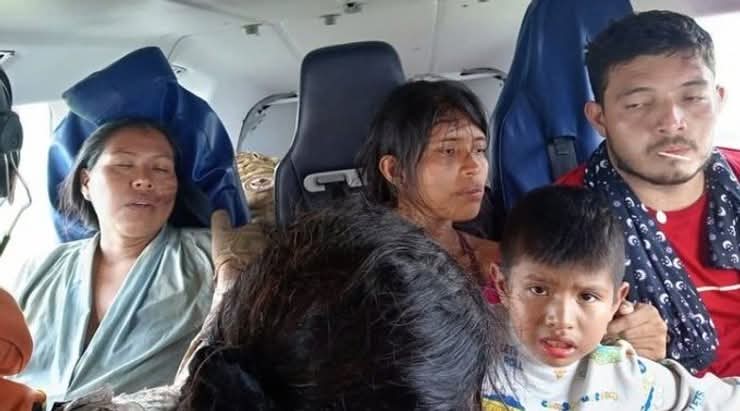
Four adults and a child have been found alive after spending nearly two days in alligator-infested waters following a plane crash in Bolivia.
The group was rescued on Friday, May 2, after local fishermen discovered the downed aircraft in the Amazonas region—about 48 hours after it was reported missing, according to Bolivian news outlets La Razón, Red Uno, and BBC News.
The small plane had departed from Baures in northern Bolivia at 12:00 p.m. local time on Wednesday, April 30, en route to the city of Trinidad.
Roughly an hour into the flight, the pilot reported “technical problems” before all communication was lost, La Razón noted.
A search and rescue operation was launched the following day, Thursday, May 1.
Among the five survivors were three women, a child, and the 29-year-old pilot.
%20(4)_1746293275.jpeg)
“They were found in excellent condition,” Wilson Avila, head of the Beni Department’s emergency operations centre, told BBC News.
According to Red Uno on Instagram, the passengers had been “huddled together on the fuselage of the small plane,” where they managed to survive for over 40 hours.
Footage shared by the outlet shows emergency responders carrying the survivors on stretchers to waiting helicopters following their rescue.

The Ministry of Defense stated that on Friday, May 2, at 7:20 a.m., an Eco Charlie EC-145 helicopter departed from Santa Cruz de la Sierra. The aircraft, equipped with a crane, tracking systems, and specialised gear from the SAR-FAB (Bolivian Air Force Search and Rescue Service), was deployed to the municipality of Baures to intensify search efforts in the area previously surveyed.
A combination of aerial reconnaissance and ground tracking eventually led to the discovery of the missing plane.
Pilot Andrés Velarde explained that the aircraft experienced engine failure, prompting an emergency landing. He aimed to land near the Itanomas River, but as the plane lost altitude, he was forced to make an emergency landing in the swamp.
%20(6)_1746293318.jpeg)
The five survivors stayed on top of the wrecked plane to avoid the threat of alligators.
Pilot Velarde told BBC News they were “surrounded by alligators that came within three meters of us,” adding, “We couldn’t drink water, and we couldn’t move anywhere else because of the alligators.”
He believes the leaking fuel from the aircraft may have kept the reptiles at bay.
Ruben Torres, head of the Beni Region Health Department, expressed relief over the rescue, saying, “I’m truly happy because, in the end, all the institutions came together to locate the missing people and save their lives.”

