
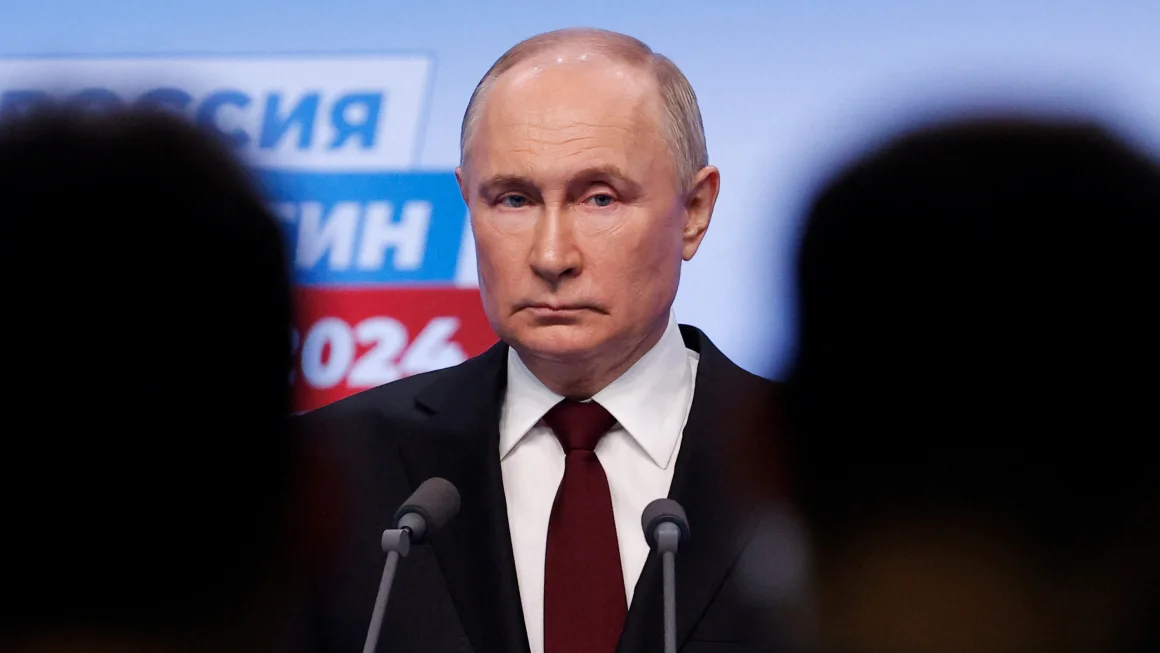
Vladimir Putin has won Russia’s re-election, securing another six-year term as Russian president, thus extending his 25-year rule in a contentious election where all significant challengers were eliminated prior to voting.
With half of the ballots counted, Putin’s vote share reached 87.3%, as announced by election officials. Turnout stood at 73.33%, according to the latest figures from Russian authorities.
Communist candidate Nikolai Kharitonov trailed in second place with just under 4%, followed by newcomer Vladislav Davankov in third and ultra-nationalist Leonid Slutsky in fourth, based on partial results.
This marks Putin’s highest vote share in any of his five presidential election victories since 2000. At 71, he is already the longest-serving Russian leader.
Following the initial results, Putin pledged to lead Russia towards accomplishing his objectives, asserting that “nobody in history has ever succeeded” in suppressing the will of Russians. Analyst Nikolai Petrov from the Chatham House foreign affairs think tank in London described the outcome as solidifying Russia as a “fully consolidated autocracy.”
Despite calls for dissent from supporters of his prominent opponent, the late Alexei Navalny, Putin dismissed the impact of protests against his government, stating that they had no bearing on the election’s outcome.
Putin also addressed Navalny’s passing for the first time, calling it a “sad event” and confirming readiness for a prisoner exchange involving the opposition figure.
When questioned by NBC, a U.S. television network, about the democratic nature of his re-election, Putin criticized the U.S. political and judicial systems, citing what he deemed as a lack of democracy and pointing to alleged use of administrative resources against presidential candidates, including an apparent reference to criminal cases against Republican candidate Donald Trump.

