
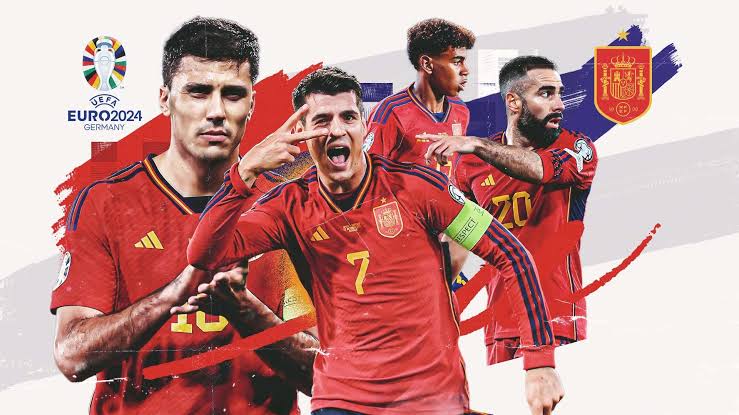
After over a decade of disappointment, Spain has returned to football’s peak by reaching Sunday’s Euro 2024 final in Berlin.
Having won two European Championships in 2008 and 2012, and the 2010 World Cup, La Roja were expected to dominate football for years. However, they quickly fell from grace as the players intended to replace their golden generation failed to meet expectations.
Spain’s 2014 World Cup defense ended in humiliation with a 5-1 defeat by the Netherlands, leading to an early exit in the group stage. They were eliminated by Italy in the Euro 2016 last-16, with newspaper Marca declaring it “The End” for Vicente del Bosque’s La Roja.
At the 2018 World Cup, Spain fell in the last-16 to Russia on penalties, despite completing over 1,000 passes. A promising run to the semi-finals at Euro 2020 was followed by another painful last-16 exit in the 2022 World Cup against Morocco.
Despite these setbacks, the Spanish football federation believed the team was close to where it needed to be. They replaced coach Luis Enrique with Luis de la Fuente, who had successfully coached national youth sides for years.
After some early struggles, including a 2-0 defeat by Scotland last year, Spain stuck with their coach and began to see results. De la Fuente led them to their first silverware in 11 years by winning the Nations League last summer, promising it was only the beginning.
This promise has been fulfilled, with La Roja dominating Euro 2024, excelling in the toughest group featuring defending champions Italy, and defeating hosts Germany and France.
Remarkably, this success comes despite a line-up with few recognisable stars beyond Manchester City midfielder Rodri. Barcelona winger Lamine Yamal, 16, is just starting his career but is expected to dazzle the football world for years. On the opposite flank, Nico Williams has emerged and may secure a big move from Athletic Bilbao this summer.
The team features many ‘misfits,’ including Marc Cucurella, who has struggled at Chelsea, and Aymeric Laporte, now based in Saudi Arabia, among others who are not standouts for their clubs. However, their lack of superstars poses no problems. “I have 26 great players, and I’m just lucky that they are Spanish,” said De la Fuente.
Unlike final opponents England, whose coach Gareth Southgate is sometimes reluctant to replace struggling icons, or France building around a sub-par Kylian Mbappe, Spain treats everyone equally. Barcelona’s Pedri explained before the tournament, “The big difference to all the (other) countries is that we are a team and there is no one leader above the rest.”
De la Fuente, more pragmatic than his predecessor, is benefitting from his willingness to try different approaches. Spain still enjoys possession but also releases the explosive Yamal and Williams, fires in crosses, and lets them take risks to beat their markers. While other coaches might opt for one winger and a possession-friendly midfielder on the other flank, the 63-year-old goes full throttle with both.
Luis Enrique’s Spain tried to pass teams to death, but at times in Euro 2024, La Roja have had less than 50 percent possession. De la Fuente knows his players better than most of his counterparts, having coached the majority of them over the past few years. He won the U19 Euros with Spain in 2013, the U21 Euros in 2019, and silver at the Tokyo Olympics in 2021. Seven of the starting line-up from the Olympics have played at Euro 2024.
“I know the players very well, what we had available to us, and we needed time to do what we are seeing now,” said the coach this week. “I am not surprised by it. Cooking this up is a long process, but we knew the decisions and the path we had to take.”
This continuity has proven vital in the international game, where coaches do not typically have long to work with their players, and has brought Spain to the verge of glory once more.
AFP

