
A senior Sudanese general has stated that the army will continue its offensive despite international attempts to negotiate a ceasefire in the ongoing 17-month civil war.
“Peace talks can proceed, but the army will not halt operations,” Assistant Commander-in-Chief Lt Gen Ibrahim Gabir told the BBC.
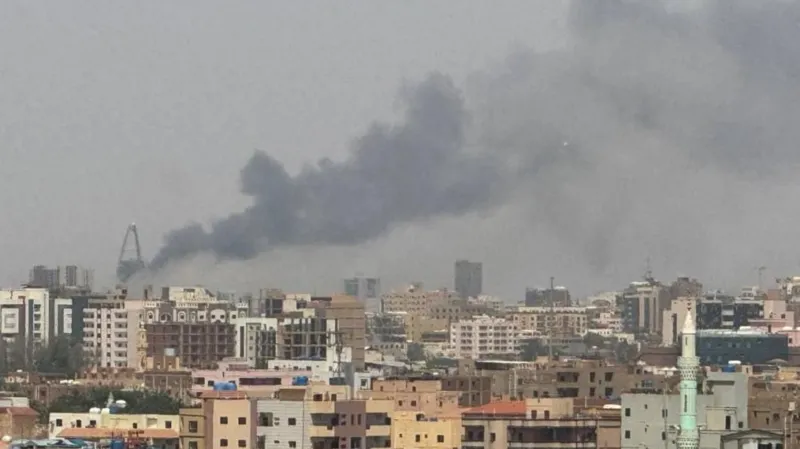
His comments came shortly after the army initiated an operation to reclaim control of the capital, Khartoum, from the paramilitary Rapid Support Forces (RSF).
The conflict between the two factions began in April of last year, following a power struggle over the country’s future. This has resulted in a humanitarian crisis, with over half the population facing hunger and millions displaced from their homes.
In the extensive interview, the general suggested that Sudanese authorities had engaged in arms dealings with Iran and denied claims of famine in the country.
“When the parties agree to a ceasefire, the army can stop,” he stated, reiterating the army’s demands for the RSF to withdraw from occupied areas.
“Let the international community pressure the militia to cease fighting and vacate the houses it has taken,” he added, expressing greater confidence that the army now has the upper hand.
Fresh diplomatic efforts to negotiate a halt to hostilities have not yielded progress, US Sudan Envoy Tom Perriello acknowledged this week.
“The situation is extremely dire, and those who could stop it seem eager to escalate it,” he told journalists in Nairobi, Kenya.
He noted some improvement in humanitarian access, with hundreds of aid trucks reaching previously blocked areas.
“However, we obviously need to operate on a significantly larger scale,” he emphasized.
For several months, the army had blocked aid shipments through a vital border post controlled by the RSF between Chad and Darfur. In August, they agreed to allow resumption, and the RSF committed to facilitating deliveries in its territories.
Gen Gabir rejected claims that the army was stalling on approving paperwork for humanitarian organizations, citing the number of visas and permits issued.
He pointed out that the RSF had looted humanitarian supplies and continued to obstruct aid deliveries to the besieged city of el-Fasher in North Darfur.
He reiterated the army’s denial of famine, placing the blame for the hunger crisis on the RSF.
In August, a group of UN-backed experts reported famine conditions at the Zamzam camp for displaced individuals near el-Fasher, using available data to reach this conclusion, while noting other areas of Sudan were also at risk.
However, the Sudanese government has not officially declared famine, which would trigger a UN Security Council resolution allowing relief agencies to provide cross-border assistance.
The army is focused on the Darfur-Chad border, claiming it serves as a conduit for mercenaries and arms, particularly from the United Arab Emirates.
Gen Gabir remarked that the UAE’s alleged support for the RSF “significantly impacts the war’s dynamics,” noting the RSF’s militia status and advanced weaponry. He asserted, “At the end of the day, they won’t win this war; they are just a militia.”
The UAE denies supporting the RSF, but the UN has stated there is credible evidence of such support.
A recent investigation by the *New York Times* provided extensive details on the matter. Additionally, a report by Human Rights Watch documented visual evidence of weapons supplied by the UAE, alongside those from China, Iran, Russia, and Serbia, all manufactured last year.
Gen Gabir hinted that the army had engaged in discussions about weapon purchases with Iran, stating, “You can find weapons if you have money and payment facilitation.”
“Iran will not provide weapons unless paid in cash. We don’t have cash… The most important thing is that we are a government, and we have the right to engage with everyone.”
He refuted allegations of war crimes cited in a recent UN report, which documented indiscriminate bombings, attacks on schools and hospitals, and arbitrary detention and torture.
“The Sudanese army is not composed of angels,” he acknowledged. “Crimes can be committed, but I’m referring to individuals.”
He refrained from predicting the war’s duration, with another Sudanese defense official comparing it to America’s 20-year struggle against the Taliban in Afghanistan.
Previous Sudanese civil wars have lasted for many years, according to the Sudan War Monitor, a research group tracking the conflict.
“The main factor prolonging this war is Sudan’s vast size and the scale of both warring parties, making it impossible for any single battle to decide the war’s outcome,” they communicated to the BBC via email.
For Gen Gabir, the vision for the future was clear: “Sudan will prevail, and Sudan will be rebuilt.”

