
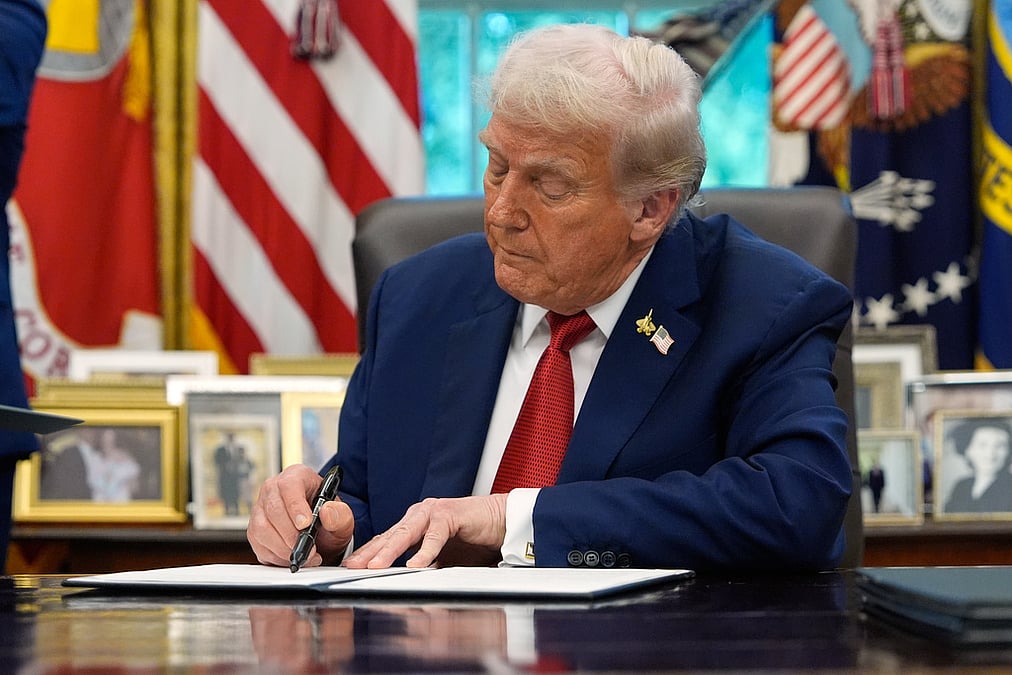
US President Donald Trump on Thursday night reignited his global trade war with the announcement of sweeping new tariffs on pharmaceuticals, heavy trucks, home renovation fixtures, and furniture — one of the most aggressive protectionist steps of his presidency.
The late-night declaration marks his toughest trade move since April, when he shocked Washington and its allies with reciprocal tariffs on nearly every US trading partner. Posting on Truth Social, Trump said that beginning October 1, “we will be imposing a 100% tariff on any branded or patented pharmaceutical product, unless a company is building their pharmaceutical manufacturing plant in America.”
The announcement immediately drew criticism from abroad. Australia, which exported about $1.35 billion worth of pharmaceuticals to the US in 2024, voiced strong concerns. Health Minister Mark Butler warned Friday that the move was “not in the American consumers’ interest … particularly given the degree to which their exporters to Australia benefit from that free trade as well.”
In a separate post, Trump also revealed a 25% tariff on “all ‘Heavy (Big) Trucks’ made in other parts of the world,” aimed at protecting US-based manufacturers like Peterbilt, Kenworth, Freightliner, and Mack Trucks. Competitors such as Sweden’s Volvo and Germany’s Daimler, which owns Freightliner and Western Star, saw their shares plunge in after-hours trading. Trump defended the measure as necessary “for many reasons, but above all else, for national security purposes.”
The tariffs follow a Section 232 investigation earlier this year into imported trucks, a rarely used trade law that gives presidents broad authority to restrict imports deemed a threat to national security. Trump has frequently relied on this provision to back his efforts to revive US manufacturing and punish what he calls unfair foreign practices.
Trump also targeted home renovation and furniture imports, announcing that starting October 1, “a 50% tariff on all kitchen cabinets, bathroom vanities and associated products” will take effect, alongside “a 30% tariff on upholstered furniture.” According to the US International Trade Commission, imports — mostly from Asia — made up 60% of all furniture sold in 2022, including 86% of wood furniture and 42% of upholstered items.
Shares of Wayfair and Williams Sonoma, both reliant on imported goods, slid sharply after the news. Economists cautioned that the escalation risks driving up inflation in the US, the world’s largest economy, which remains heavily dependent on imports.
The sweeping measures are part of Trump’s broader push for a “manufacturing renaissance,” building on earlier actions that included a baseline 10% tariff on all countries, plus higher rates for nations running large trade surpluses with the US. He has also used emergency powers to impose tariffs on close partners like Canada and Mexico, as well as China, citing issues ranging from fentanyl to immigration.
While it remains uncertain how these latest tariffs will fit into the existing web of restrictions, the message is clear: Trump is doubling down on protectionism, despite warnings from allies, businesses, and investors about the risks to global supply chains and American consumers.

