
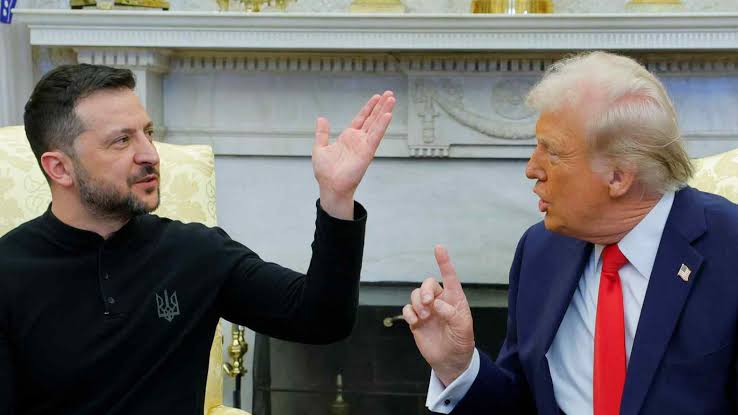
The Trump administration has suspended all U.S. military aid to Ukraine, blocking billions in critical supplies as the White House pressures Kyiv to negotiate peace with Vladimir Putin.
The decision affects shipments of ammunition, vehicles, and other equipment, including those previously approved under President Joe Biden.
Tensions escalated after a heated exchange at the White House on Friday, where Donald Trump warned Ukrainian President Volodymyr Zelenskyy that he was “gambling with” a third world war. Zelenskyy was reportedly told to return “when he is ready for peace.”
A senior administration official told Fox News that the aid suspension is a temporary measure, not a permanent termination. Bloomberg reported that all U.S. military equipment not yet in Ukraine, including weapons in transit, would be held back. Trump has directed Defense Secretary Pete Hegseth to implement the pause.
The decision followed a high-level White House meeting attended by Hegseth, Vice President JD Vance, Secretary of State Marco Rubio, Director of National Intelligence Tulsi Gabbard, and Middle East envoy Steve Witkoff.
A White House official told The Washington Post, “The president is focused on peace. We need our partners to be committed to that goal as well. We are pausing and reviewing our aid to ensure it contributes to a solution.”
Ukrainian officials have expressed alarm over the move. Oleksandr Merezhko, chair of Ukraine’s parliamentary foreign affairs committee, warned that halting aid could benefit Russia. “To stop aid now means helping Putin,” he told Reuters.
The advocacy group Razom for Ukraine criticized Trump’s decision, stating, “By abruptly halting military assistance, President Trump is abandoning Ukrainians and giving Russia a green light.” They urged the White House to reverse course.
Since Russia’s 2022 invasion, the U.S. has provided $175 billion in aid to Ukraine, according to the Committee for a Responsible Federal Budget. Before leaving office, Biden approved an additional $5.9 billion in security and budgetary support.
U.S. aid to Ukraine has been delivered through military assistance programs and budgetary support via a World Bank trust fund. Some of this funding covers salaries for Ukrainian teachers and doctors, ensuring government operations continue amid the war.
Weapons assistance has been facilitated through the Presidential Drawdown Authority (PDA), which allows the rapid transfer of military equipment, and the Ukraine Security Assistance Initiative (USAI), which procures weapons from defense contractors. The U.S. has pledged $31.7 billion in weapons aid through PDA, with over $20 billion already shipped.
Monday’s announcement primarily impacts previously approved aid that had not yet been delivered. Trump has not authorized any new assistance, and a fresh congressional aid package appears unlikely in the near future.
Earlier that day, Trump criticized Zelenskyy for suggesting that the war’s end could be “very, very far away.” He posted on social media, “This is the worst statement Zelenskyy could have made, and America will not tolerate it much longer!” He further claimed that Zelenskyy had no interest in peace as long as he had U.S. and European support.
Later, Trump warned that Zelenskyy “won’t be around very long” unless he agreed to a deal on U.S. terms.
Reports also suggest the Trump administration is working on plans to restore ties with Russia, including lifting some sanctions. The White House has reportedly asked the State and Treasury Departments to draft a list of sanctions that could be eased as part of broader diplomatic and economic negotiations with Moscow.
In an interview with Fox News before the aid suspension was announced, Vice President Vance suggested that securing American economic interests in Ukraine’s future could serve as a security guarantee. He referenced a minerals deal that had brought Zelenskyy to Washington, only for him to leave empty-handed after a tense meeting with Trump.
“If you want real security guarantees, the best way to prevent another Russian invasion is to give Americans an economic stake in Ukraine’s future,” Vance said.

