
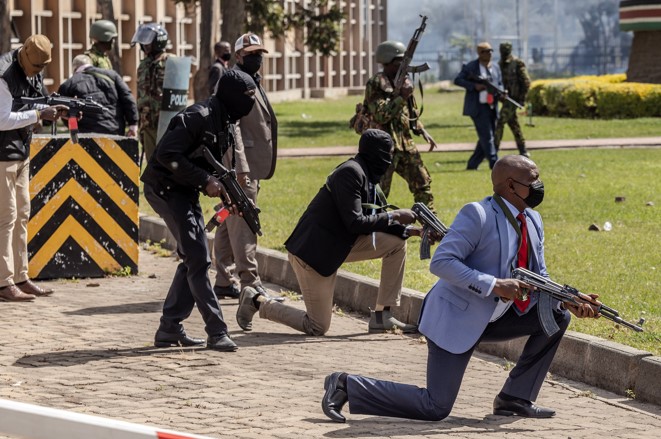
The death toll from protests in Kenya has risen to 13, an official from the main doctors’ association told AFP on Wednesday. The anti-tax hike rallies turned violent when police opened fire at demonstrators who ransacked parliament.
The unprecedented scenes on Tuesday, which left parts of parliament ablaze and injured scores of people, have shocked Kenyans and prompted President William Ruto’s government to deploy the military.
The mainly youth-led rallies began mostly peacefully last week, with thousands of demonstrators marching in the capital Nairobi and across the country against the tax increases.

Tensions sharply escalated on Tuesday afternoon when police officers fired live rounds at crowds, which later ransacked the parliament complex.
Hours later, Defence Minister Aden Bare Duale announced that the government had deployed the army to support the police in addressing the “security emergency” in the country.
“So far, we have at least 13 people killed, but this is not the final number,” said Simon Kigondu, president of the Kenya Medical Association, adding that he had never seen “such a level of violence against unarmed people.”
“Deaths, mayhem” read the front-page headline of the Standard newspaper, while the Daily Nation described the situation as “Pandemonium,” saying, “The foundations of the country have been shaken to the core.”
An official at Kenyatta National Hospital in Nairobi said Wednesday that medics were treating “160 people… some with soft tissue injuries, some with bullet wounds.”
In a late-night press briefing, President Ruto warned that his government would take a tough line against “violence and anarchy,” likening some of the demonstrators to “criminals.”
“It is not in order or even conceivable that criminals pretending to be peaceful protesters can reign terror against the people, their elected representatives, and the institutions established under our constitution and expect to go scot-free,” he said.
The government has been taken by surprise by the intensity of opposition to its tax proposals, mostly led by young, Gen-Z Kenyans, which culminated in the scenes at parliament that played out live on television.
Images shared on local TV stations showed the building ransacked, with burnt furniture and smashed windows.
As police fired at the angry crowds, leaving several bodies on the ground, protest organizers urged people to walk home together and “stay safe.”
A heavy police presence was deployed around parliament early on Wednesday, according to an AFP reporter, with the smell of tear gas still in the air.
A policeman standing in front of the broken barricades told AFP he had watched the scenes unfold on TV.
“It was madness; we hope it will be calm today,” he said.
Earlier on Tuesday, the rallies in various Kenyan cities had been largely peaceful.
However, tensions escalated in Nairobi later in the day, with some protesters hurling stones at police, who deployed tear gas and water cannons before firing live bullets.
AFP journalists saw three people bleeding heavily and lying motionless on the ground near parliament.
The unrest has alarmed the international community, with the White House appealing for calm and more than 10 Western nations—including Canada, Germany, and Britain—saying they were “especially shocked by the scenes witnessed outside the Kenyan Parliament.”
UN chief Antonio Guterres and the head of the African Union Commission, Moussa Faki Mahamat, have also expressed deep concern.
Veteran opposition leader Raila Odinga, who heads the Azimio coalition, accused the government of unleashing “brute force on our country’s children.”
Rights watchdogs have also accused the authorities of abducting protesters.
The police have not responded to AFP requests for comment.
Long-running grievances over the rising cost of living spiraled last week as lawmakers began debating proposed tax hikes in the 2024 finance bill.
The cash-strapped government says the increases are needed to service the country’s massive debt of some 10 trillion shillings ($78 billion), equal to roughly 70 percent of Kenya’s GDP.
After rolling back some of the more controversial proposals—which would have affected bread purchases, car ownership, and financial and mobile services—the government now intends to increase fuel prices and export duties.
Kenya’s treasury has warned of a gaping budget shortfall of 200 billion shillings, following Ruto’s decision to roll back some of the tax hikes.
While Kenya is among East Africa’s most dynamic economies, a third of its 52 million population lives in poverty.
AFP

