
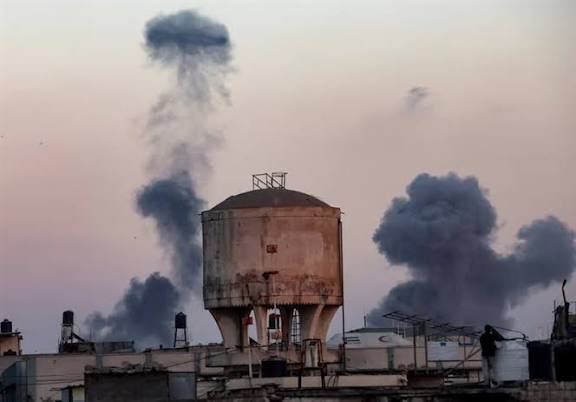
The Israeli military announced on Sunday, October 19, that a ceasefire in Gaza had resumed after a violent escalation that tested the month-old U.S.-brokered truce. The renewed hostilities began with an attack that killed two Israeli soldiers, prompting a series of retaliatory airstrikes that left 26 people dead in Gaza.
Aid shipments into the enclave are expected to resume on Monday following U.S. pressure, according to an Israeli security source. Israel had earlier halted supplies, accusing Hamas of a “blatant” violation of the truce.
The Israeli strikes targeted Hamas positions across Gaza, including field commanders, tunnels, and weapons depots. One of the strikes reportedly hit a former school sheltering displaced people in Nuseirat. Local officials confirmed that at least 26 people were killed, including a woman and a child.
U.S. President Donald Trump’s envoy, Steve Witkoff, and his son-in-law, Jared Kushner, are expected to travel to Israel on Monday to engage in discussions over the fragile ceasefire.
Israeli Prime Minister Benjamin Netanyahu said he had ordered the military to respond firmly to what he called Hamas’ violations of the agreement. Meanwhile, Hamas’ armed wing insisted it remained committed to the ceasefire and denied knowledge of the clashes reported in Rafah.
Fearing a breakdown of the truce, some Palestinians fled their homes in Khan Younis, while others rushed to markets to stock up on essential supplies amid ongoing uncertainty.
Israel’s Defence Minister, Israel Katz, stated that the “yellow line” marking the military pullback zone would be clearly defined, warning that any attempt to cross it would be met with fire. Hamas, in response, accused Israel of multiple ceasefire breaches, claiming 46 deaths and disruptions to vital humanitarian supplies.
A key issue continues to be the return of the bodies of deceased Israeli hostages. Israel has accused Hamas of delaying the process, while Hamas maintains that special equipment is required to recover corpses buried under rubble. So far, Hamas has released all 20 living hostages and handed over 12 of the 28 deceased captives.
The Rafah border crossing remains closed and will only reopen once Hamas fulfils its obligations under the ceasefire. Although aid deliveries through another crossing have slightly increased, the United Nations warns that much more assistance is urgently needed to alleviate widespread hunger and suffering in Gaza.
Significant challenges still stand in the way of a lasting peace, including unresolved questions about Hamas’ disarmament, Gaza’s future governance, the structure of an international “stabilisation force,” and progress toward the creation of a Palestinian state.

