
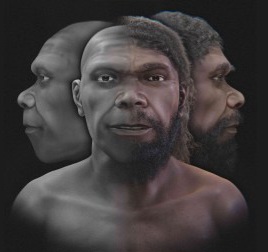
The face of the oldest known human has been reconstructed for the first time, revealing a man described as “strong and serene.” Brazilian graphics expert Cicero Moraes created the reconstruction using a 3D scan of a skull to bring the human back to life.
The fossils originated from the Jebel Irhoud remains, named after the site in Morocco where they were found. They provided evidence that humans, or Homo sapiens, evolved 100,000 years earlier than previously thought, and demonstrated that our ancestors left the “cradle of mankind” in East Africa and spread across the continent millennia earlier than previously evidenced.
Mr. Moraes explained the process, stating, “Initially, I scanned the skull in 3D using data provided by researchers at the Max Planck Institute.”

“Then I proceeded with the facial approximation, which consisted of crossing several approaches, such as anatomical deformation.”
This technique involved mapping the 3D skull diagram onto a “donor” skull prototype, which was based on an adult male with a low body mass index.
Mr Moraes said he chose to give the skull a male face based on the “robust and masculine” features of the skull.

Additional information from contemporary humans was utilized to estimate the thickness of the soft tissue and to predict the likely projection of the nose and other facial structures.
“The final face results from the integration of all this data, producing two sets of images—one objective, focusing on technical elements, devoid of hair and presented in greyscale,” Mr. Moraes explained.

Without hair and skin pigmentation
“The other is artistic, with pigmentation of the skin and hair.”

With hair and skin pigmentation
The skull itself is a composite of various fossils, meticulously reconstructed to form a unified whole described by the designer as “excellent and anatomically coherent.”
The Max Planck Institute, which provided the skull data, noted that the Jebel Irhoud remains exhibited a “modern-looking face and teeth, with a large but more archaic-looking braincase.”
According to the Institute, genetic changes affecting brain connectivity, organization, and development played a significant role in shaping the skull structures found today.
Moraes concurred and likened the Jebel Irhoud skull to that of an archaic Homo sapiens, suggesting it shares some characteristics with Neanderthals or Heidelbergensis (extinct human relatives).

“It’s fascinating to observe the differences and similarities in the structures of these skulls and faces across millennia.”
Fossils from the Jebel Irhoud site were initially discovered in the 1960s and initially estimated to be about 40,000 years old. However, upon revisiting the site and applying new techniques, scientists determined the bones to be approximately 300,000 years old.
Jean-Jacques Hublin of the Max Planck Institute commented, “We used to believe there was a cradle of mankind 200,000 years ago in East Africa. In reality, our findings indicate that Homo sapiens spread across the entire African continent even earlier, around 300,000 years ago.”
This discovery surpassed the previously known oldest Homo sapiens remains found in Omo Kibish, Ethiopia, which were dated to 195,000 years old.

