
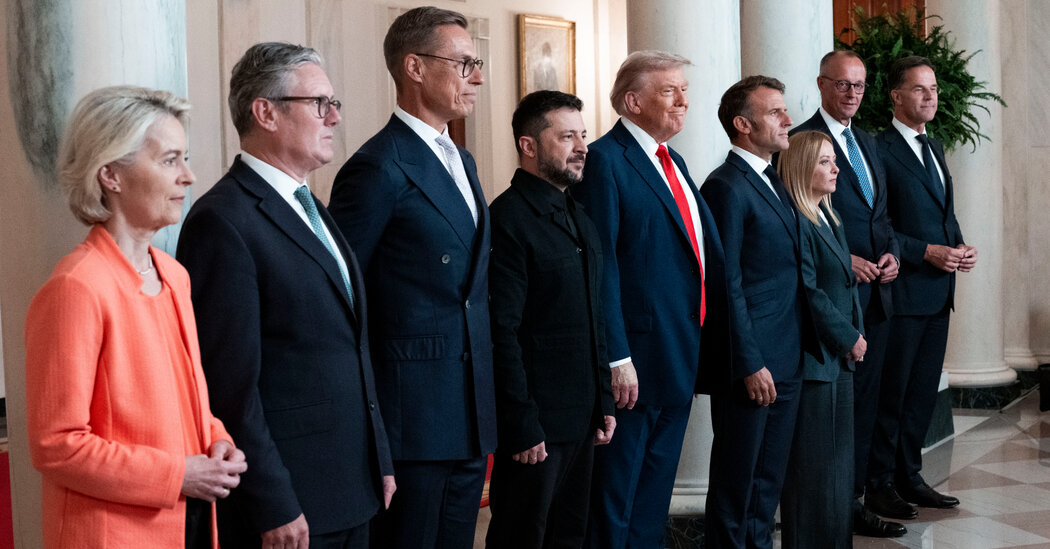
European leaders have joined Ukrainian President Volodymyr Zelensky in insisting that any peace talks to end the war in Ukraine must begin with freezing the current front line, warning that Russia remains unwilling to pursue genuine peace.
In a joint statement signed by 11 leaders, including UK Prime Minister Keir Starmer, they expressed “strong support” for US President Donald Trump’s stance that “the fighting should stop immediately and that the current line of contact should be the starting point for negotiations.”
However, Russian Foreign Minister Sergei Lavrov on Tuesday rejected the proposal, insisting that Moscow was only interested in a “long-term, sustainable peace” — implying that a frontline freeze would amount to nothing more than a temporary truce.
The European statement also condemned what it described as “Russia’s stalling tactics,” underscoring frustration with Moscow’s continued intransigence.
Trump, who has at times taken a conciliatory tone toward Russia, is now planning direct talks with President Vladimir Putin in Budapest. However, a preparatory meeting between US Secretary of State Marco Rubio and Lavrov has yet to be finalised.
The US president spoke with Putin by phone last week, a day before meeting Zelensky at the White House. Multiple Western sources reported that Trump pressed Zelensky to surrender parts of the eastern Donbas region — including areas of Donetsk and Luhansk — as part of a possible deal with Moscow. Some accounts described the exchange as heated, though Zelensky later referred to the talks as “frank.”
Zelensky reiterated on Monday that Ukraine would not withdraw from the region, warning that doing so could enable future Russian aggression. “Ukraine’s position has not changed,” he said, noting that while Russia controls most of Luhansk, Ukraine still holds about a quarter of Donetsk, including the key cities of Slovyansk and Kramatorsk.
Trump has since denied urging Zelensky to cede the Donbas but has embraced the idea of a ceasefire based on the existing front lines. “Let it be cut the way it is,” he said on Monday. “It’s cut up right now. I think 78% of the land is already taken by Russia… I said: cut and stop at the battle line. Go home. Stop fighting, stop killing people.”
Despite this, Moscow continues to reject the notion of freezing the front line. Kremlin spokesperson Dmitry Peskov said Russia’s stance “has not changed,” reiterating demands for the complete withdrawal of Ukrainian forces from the eastern regions.
Lavrov repeated the same message on Tuesday, stressing the need to address the “root causes of the conflict” — Kremlin language referring to Moscow’s calls for recognition of Russian sovereignty over the Donbas and the demilitarisation of Ukraine, conditions Kyiv and its allies consider unacceptable.
The Kremlin has downplayed the likelihood of an imminent Trump-Putin summit, with Peskov saying, “We cannot postpone what has not been finalised.” Although Lavrov and Rubio were expected to meet this week to prepare for the talks, no date has been confirmed.
A possible meeting between Trump and Putin in Hungary would also require at least one EU country to allow Russian airspace access. With Putin under an international arrest warrant for war crimes, both Poland and Lithuania have vowed to execute the warrant if his aircraft passes through their territory. Bulgaria, however, has hinted it might permit passage.
“When efforts are made for peace, it is only logical that all sides contribute to making such a meeting possible,” Bulgarian Foreign Minister Georg Georgiev said.
Trump and Putin last met in Alaska in August during an emergency summit that produced few tangible results but marked Putin’s partial return to the global stage. Trump later proposed a bilateral summit between Putin and Zelensky, but Russia conditioned any such meeting on addressing the “root causes” of the war, effectively stalling the idea.
Since beginning his second term, Trump has repeatedly described the ongoing Russia-Ukraine war — now entering its fourth year — as “difficult” to resolve.

