BBC Africa Eye investigates how a WhatsApp group helped save more than 50 Malawian women trafficked to Oman to work in slave-like conditions.
Warning: Some people may find details in this story distressing.
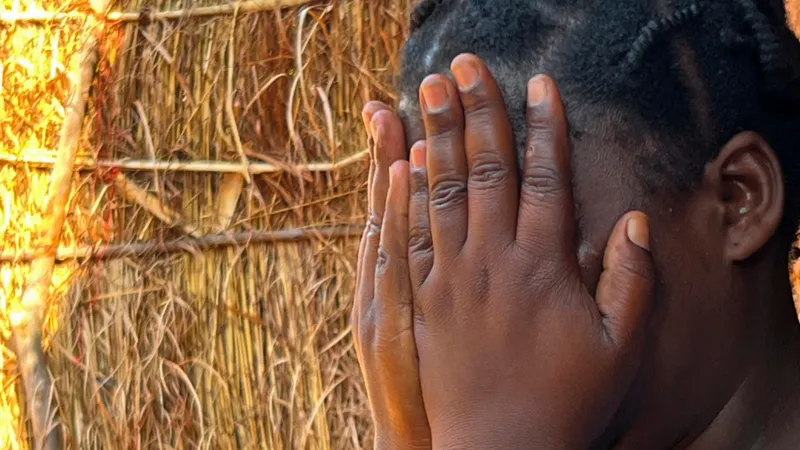
A 32-year-old woman breaks down in tears as she relives the abuse she experienced when, hoping for a better life, she found herself working as a maid in Oman.
Georgina, who like all the trafficked women interviewed by the BBC opted to only use her first name, believed she had been recruited to work as a driver in Dubai.
She had owned a small business in Lilongwe, Malawi’s capital, and was managing when approached by an agent saying she could earn more money in the Middle East.
It was not until the plane landed in Muscat, the capital of Oman, that she realised she had been deceived and subsequently trapped by a family who made her work gruelling hours, seven days a week.
“I reached a point where I couldn’t take it,” she says, detailing how she got as little as two hours’ sleep.
She had not been there long when her boss began forcing her to have sex with him, threatening to shoot her if she said anything.
“It wasn’t only him,” she says. “He would bring friends and they would pay him after.”
She struggles to speak as she recounts how she was forced into anal sex: “I got badly injured. I became so distraught.”
It is estimated there are around two million female domestic workers in the Gulf Arab states. In a survey of 400 women in Oman by migrant charity Do Bold, published by the 2023 US State Department Trafficking in Persons Report, almost all were found to be victims of human trafficking.
Nearly a third said they were sexually abused, while half reported physical abuse and discrimination.
After several weeks, Georgina became desperate and in a post on Facebook she begged for someone to help her.
Thousands of miles away in the US state of New Hampshire, 38-year-old Malawian social media activist Pililani Mombe Nyoni saw her message and began to investigate.
She got in touch and got the Facebook post removed for Georgina’s safety and passed on her own WhatsApp number, which began to circulate in Oman. She soon realised it was a wider problem.
“Georgina was the first victim. Then it was one girl, two girls, three girls,” she told the BBC.
“That’s when I said: ‘I am going to form a [WhatsApp] group because this looks like human trafficking.'”
More than 50 Malawian women working as domestic workers in Oman joined the group.
Soon the WhatsApp group was full of voice notes and videos, some too harrowing to watch, detailing the horrific conditions the women were enduring. Many had their passports taken away as soon as they arrived, preventing them from leaving.
Some told of how they had shut themselves in toilets to secretly send their pleading messages.
“I feel like I am in prison… we can never escape,” one said. “My life is really in danger,” another said.
Ms Nyoni began speaking to human trafficking charities in Malawi and was introduced to Ekaterina Porras Sivolobova, founder of Do Bold, based in Greece.
Do Bold works with a community of migrant workers in the Gulf countries, identifying victims of trafficking or forced labour and then negotiates with their employer for them to be released.
“The employers pay an agent for providing a domestic worker. One of the most common challenges that we face is that the employer or agent says: ‘I want my money back, then she can go home’,” Ms Sivolobova told the BBC.
“The laws that are in place [in Oman] prohibit a domestic worker to leave the employer. She cannot change jobs and she cannot leave the country – no matter how you are treated.”
This is what is known in the Middle East as the “kafala” labour system, which ties workers to their employers for the duration of their contract.
Oman’s National Committee to Combat Human Trafficking told the BBC the relationship between the employer and the domestic worker was contractual – and unsettled disputes can be referred to a court within a week.
It added that an employer was not allowed “to impose any form of forced labour on the worker” and could not keep a worker’s “passport and private documents without his written consent”.
After three months in Muscat, and with the help of Ms Nyoni and someone in Oman, Georgina returned to Malawi in June 2021.
“After I helped Georgina, I felt so mad, I felt so angry,” says Ms Nyoni.
Georgina’s case allowed her to raise the alarm within Malawi – and pressure began mounting on the government to intervene.
Malawian charity Centre for Democracy and Economic Development Initiatives (CDEDI) launched an Oman rescue campaign, calling on the authorities to bring the women home.
Blessings was another of the women in Ms Nyoni’s WhatsApp group. The 39-year-old had travelled to Muscat in December 2022, leaving her four children with her sister, Stevelia, in Lilongwe.