

Think Africa ry, one of the most impactful associations run by people of African decent in Finland are having their week from 27 Nov- 4 Dec with the theme “Connecting and Reconnecting.” Myriam Munezero is the incumbent chairperson of the association. In this interview, she opined that the achievements of people of African descent are underreported in the media, she also explained the benefits of joining Think Africa ry.
1. Please introduce yourself to our readers?
I am Myriam Munezero, a wearer of many hats. I am a mother, a wife, the Chairperson of Think Africa ry, and a Data Analyst at F-Secure. My mission in life is to support the actualisation of the potential held by people
2. It’s been four years since you became the chairperson of Think Africa ry. Could you share your experiences with us?
It has truly been a humbling and learning experience. The biggest learning and probably the most challenging is learning to work with a lot of people. leading, listening and communicating effectively; and building a cohesive community of people with shared interests. I still do not have a good approach for the above, as that is something I am still learning even in my fourth year of being the Chairperson.
But being at Think Africa has been a very rewarding experience. I have found my family away from home. We have over 25 nationalities, when you think about all that you get to learn from this kind of diversity.
The members and volunteers are people who want to see a better life, better participation, better representation of the African diaspora whether in Finland or elsewhere, and I enjoy being in such company and coming up with ideas to solutions. And in my position, I try to see ways in which the organisation can support the fruition of these ideas.

Myriam Munezero, Think Africa ry Chairperson
Photo Credit: Jukka Luoma
3. Why should I join Think Africa ry and how to join?
I think many people don’t know the benefits of being a member. We have people that follow us and participate in activities, volunteer but they don’t become a member, that pays the 15€ annual membership fee. The advantage of being a member is that you get to take advantage of the opportunities and perks that are not available for non-members. For example, through our partners we get free tickets to events, like in September, there were tickets to the whole Love and Anarchy, the biggest film festival in Finland and their gala events.
For those that are active members, they get to develop several skills such as event management, project planning, grant writing, effective communication with different people, teamwork and working with partners, and they get to build new networks from different sectors in Finland.
Then there are also times we have employment or freelance opportunities that are only available internally to members because knowledge of the organisation is needed.
In addition, members get to be part of the different member forums on Slack and WhatsApp and get to share information and experiences.
These and much more are some of the reasons to join
To join and become a member is simple, go to our website (Think Africa. fi) and click on the ‘become’ a member button at the top right-hand side of the website, or go directly through this link https://holvi.com/shop/think-africa-membership/. If any difficulties arise, call or WhatsApp us at 0505534444, or email us at info@thinkafrica.fi and we can help you.
4. Could you tell us the role Think Africa played in the just concluded Helsinki Film Festival 2021 which featured some African films.
Among some of the things that Think Africa cares about is the representation of Africa and Africans. The partnership with Helsinki International Film Festival and the other partners we had, allowed us to showcase different stories from Africa or by African directors as told in Film. For generations, the only story for Africa has been one of despair especially when it comes to Media. Thus this collaboration was really a way for us to diversify the larger narrative about African countries and African people.
Think Africa contributed to selecting the films. We wanted films that showed normal human experiences and the different forms that can take. It’s hard to showcase everything like we missed showing a film from Nollywood, but next year, we will continue the collaboration and hope to have a selection from there, as well as other countries that were not represented in the 12, screened this year.
We also organised a panel discussion with African Film directors that were either based in Africa or Finland, to hear and understand their perspective when it comes to storytelling. We also largely contributed to ensuring that there were free tickets available for those who wished to watch the films. The film is not also the only way we try to create awareness of stories told by Africans, we also organise a Book Club.
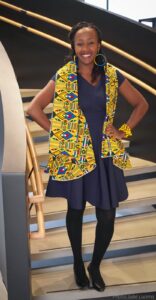
Myriam Munezero, Think Africa ry Chairperson at Oodi Library
Photo Credit: Jukka Luoma
5. The theme for Think Africa’s week in 2020 was “Africa We Want” which commensurate with AU agenda 2063. How can this be fast-tracked?
I don’t know if there is a quick way or a way to fast track it, cause 2063 is also not that far away and with the pandemic, this probably has set us back a few years as well. But it requires all of us to first understand what is in the 2063 Agenda, to understand what we are working towards, and then identify your role in it and what you can do in your own efforts…because it’s not just the responsibility of the government, public or private sector, but the responsibility of everyone who wants to truly see Africa rise.
6. The Finnish Government approved Finland’s Africa strategy which aims to diversify and deepen Finland’s relations with African countries. What factors could hinder the actualisation of the strategy?
Unfortunately, I don’t have the time to answer this one well: But people can watch the recording of the event we will host on Day 3 of Think Africa Week which will discuss the African diaspora engagement in the context of the Finland-Africa strategy
7. This year’s theme of Think Africa is “Connecting and Reconnecting” please explain?
The motivation behind the theme arose from the fact that we see a lot of disconnect between the host society and the immigrant groups and the African diaspora, as well as within the African diaspora itself. The pandemic in a way amplified this connect with the restrictions that have been in place… but looking forward, after the pandemic or having learned to live with it, how do we come together to build a more open, inclusive and cohesive society, how do we come together in the Diaspora to create stronger communities with shared interests, how do we connect and take care of our wellbeing … these are some of the things that this theme of Think Africa Week 2021 is exploring.
8. Are you of the opinion that the achievements of people of African descent are underreported in the Finnish media?
Yes, I had to even think of the last time I saw news of achievements from the Finnish media. Perhaps when Suldaan Said Ahmed became the first Somali to be a Member of Parliament. But otherwise we do not hear enough of the achievements. And that is what also hinders progress when we talk about breaking stereotypes of Africans in Finland, if the media never shows them anything different. We have tried to invite the Media to big events like Think Africa Week, but we don’t see interest or perhaps we do not have the right contacts. But next year, we wish to invest in having media partners as they have a crucial role to play.
Another aspect is that the voice of people of African descent is often missing from important conversations. Yes the Diaspora is only 1% of the Finnish population and half of that is of Somali background, but there is still a lot that is being done by this group. Take Diaspora Glitz Magazine, it makes a lot of effort to bring the achievements to light, and this positively contributes to the perceptions, it shows that things are possible in Finland, it helps create role models, and gives an outlet to reach more people. We need more of such opportunities.

